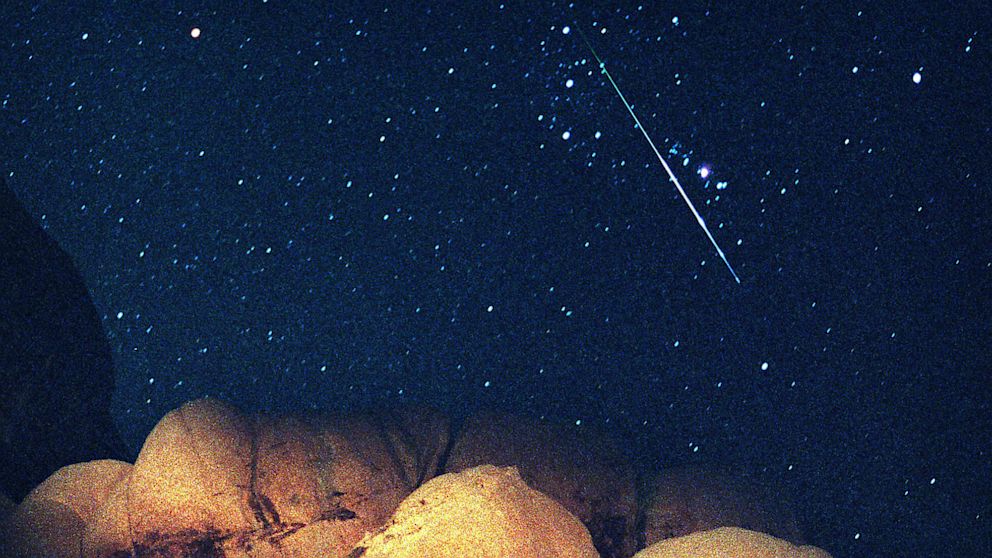
Get a sweeping prepared and find a good patch of weed since tonight a annual Perseid meteor shower is approaching to move a artistic star showers.
Every year during this time, a Earth passes by a circuit of a comet called Swift Tuttle, and we see meteors tarnishing opposite a night sky as pieces of waste from a comet enter a earth’s atmosphere during some-more than 100,000 mph and bake up. The Perseid can be seen during a final week of Jul or initial week in August, yet a rise will come tonight — a dusk of Sunday, Aug 11 into a morning of Monday, Aug 12.
According to Bill Cooke of NASA’s Meteoroid Environment Office, a best time to see a showers will be right before dawn.
“It’s not one of those things where we can go out for 30 mins after sunset,” Cooke told ABC News. He combined that while your eyes are all we need — no binoculars required — we need a integrate of mins to adjust to a dark. If a conditions are good — transparent skies and distant divided from city lights — we competence see some-more than 60 sharpened stars per hour.
Final Frontier: Space Pictures From Far Reaches of a Universe - See a Photos

The showering is manifest anywhere in a Northern Hemisphere, if continue conditions permit. According to AccuWeather, conditions should be good for observation in a Northeast, yet in a mid-Atlantic, generally Philadelphia and Washington, D.C., and on a evident West Coast prominence competence be impacted due to clouds. The crescent moon, that creates for darker skies, should assist in a visibility.
Ultimately, yet Cooke says don’t worry about all those sum and only “lie prosaic on your back, demeanour true adult and suffer a uncover — it’s nature’s fireworks display.”
If we do confirm to try outward tonight, here are some useful tips.
Where should we look? The whole sky, actually. The sharpened stars will seem to come from a constellation Perseus, in a northeastern sky. But they competence seem anywhere as discerning streaks.
Where should we not to look? Don’t demeanour during a moon, or anything else bright. You wish your eyes to get used to a dark.
Where should we go? Any place will do, yet darker is better, with a good area of open sky. Get divided from city lights if we can.
When to watch? The Perseid is best after midnight Monday morning.
Do we need any special equipment? Nope, forget a binoculars, all we need is your eyes.
Can we take pictures? Sure, we can try, yet a smartphone camera substantially won’t do. You’ll wish a camera with primer settings and a tripod is a must. Set your lens to a widest probable setting. Set a ISO (sensitivity to light) to a high number, such as 400 or 1600. And — this is vicious — your exposures need to be l-o-n-g. Experiment. An bearing of 30 seconds competence give we a margin of stars with a integrate of streaks opposite it. Or we competence try for an hour (close down a f/stop) and get really little.
What if it’s cloudy? You should be checking a continue regularly, including a radar to see what a conditions will be like. We’d advise one of these continue apps. If it is cloudy, you’re substantially out of luck, but, hey you’ll get a good night’s sleep.
Article source: http://feeds.abcnews.com/c/35229/f/654830/s/2fd09291/sc/21/l/0Labcnews0Bgo0N0CTechnology0Cperseid0Emeteor0Eshower0Eilluminate0Esky0Etonight0Eshooting0Estars0Cstory0Did0F19926255/story01.htm
Recent Comments